Weather warning
A red heat health alert will be in place across the East of England from 1am Wednesday 24 June until 11pm Thursday 25 June. Information on staying well in hot weather can be found on the GOV.UK website.

Every household is entitled to a:
We’ve also given you a year’s supply of caddy liners to start. Use these - or any other kind of bag - to line your smaller kitchen caddy. When the caddy is full, or in time for your collection day, tie the bag up, remove it from the kitchen caddy and put it in the larger caddy. Put the larger caddy out for collection on your allocated day in the same place you do for your bins.
Food waste collections happen every week.
Yes please:
No thanks:
Used cooking oil, such as you might use in a deep-fat fryer, can’t go in the food waste caddy. This is because it is could spill out of the caddy liner, or spill onto the road and members of our collection crew, or get into the machinery of the collection vehicle. It can also solidify at the digester and clog the machinery in the same way it can block drains. Cooking oil should be allowed to cool, poured back into its bottle and either used again or put into the rubbish bin in the bottle. The very best thing to do with used cooking oil, once you’ve used it as much as you can, is to save it for your next trip to the recycling centre. You can safely tip it into the used cooking oil container where it can be recycled into fuel. If you are getting rid of a small amount of oil, and it can’t be used again, wipe the pan with some kitchen towel and put the oily towel in your rubbish bin.
Liquids can’t go in the food waste caddy because they can leak on the collection vehicle, the road and our collection crew. This could cause people to slip or it might contribute to clogging the machinery of the vehicle or digester. Liquids can generally be poured down the drain, but liquids containing fats, like gravy, should be put in a container and then in the rubbish bin.
The lists above are not exhaustive, so if you are not sure whether an item is suitable, please see our waste and recycling look up:
We’re providing a year’s supply of caddy liners to help residents get started with their smaller kitchen food caddies. Caddy liners help:
The liners are designed to fit your caddies, but you can use any type of bag if you prefer.
You can reuse plastic bags from bread or vegetables, although they may not fit as snugly.
If you choose not to use liners, you’ll just need to wash your caddies occasionally.
When food waste reaches the anaerobic digester, all bags, including biodegradable and compostable ones are removed at the start of the process.
They are then sent for energy production, which is why it doesn’t matter what type of bag you use.
Recycling food waste is beneficial for the environment. It reduces greenhouse gas emissions, produces valuable resources like compost and biogas, and can lower disposal costs. Removing food waste from rubbish bags will also mean less rubbish is going to landfill.
Please visit Love Food Hate Waste for further information on waste reduction.
Weekly food waste collections keep things simpler, clean and tidy:
The food waste is taken to an anaerobic digester. This facility works just like our own digestive system.
Anaerobic digestion is a natural process where microorganisms break down organic matter in the absence of oxygen, producing biogas (a mixture of methane and carbon dioxide) and digestate. The biogas can be used for heat and electricity generation, while the digestate can be used as a nutrient-rich fertiliser.
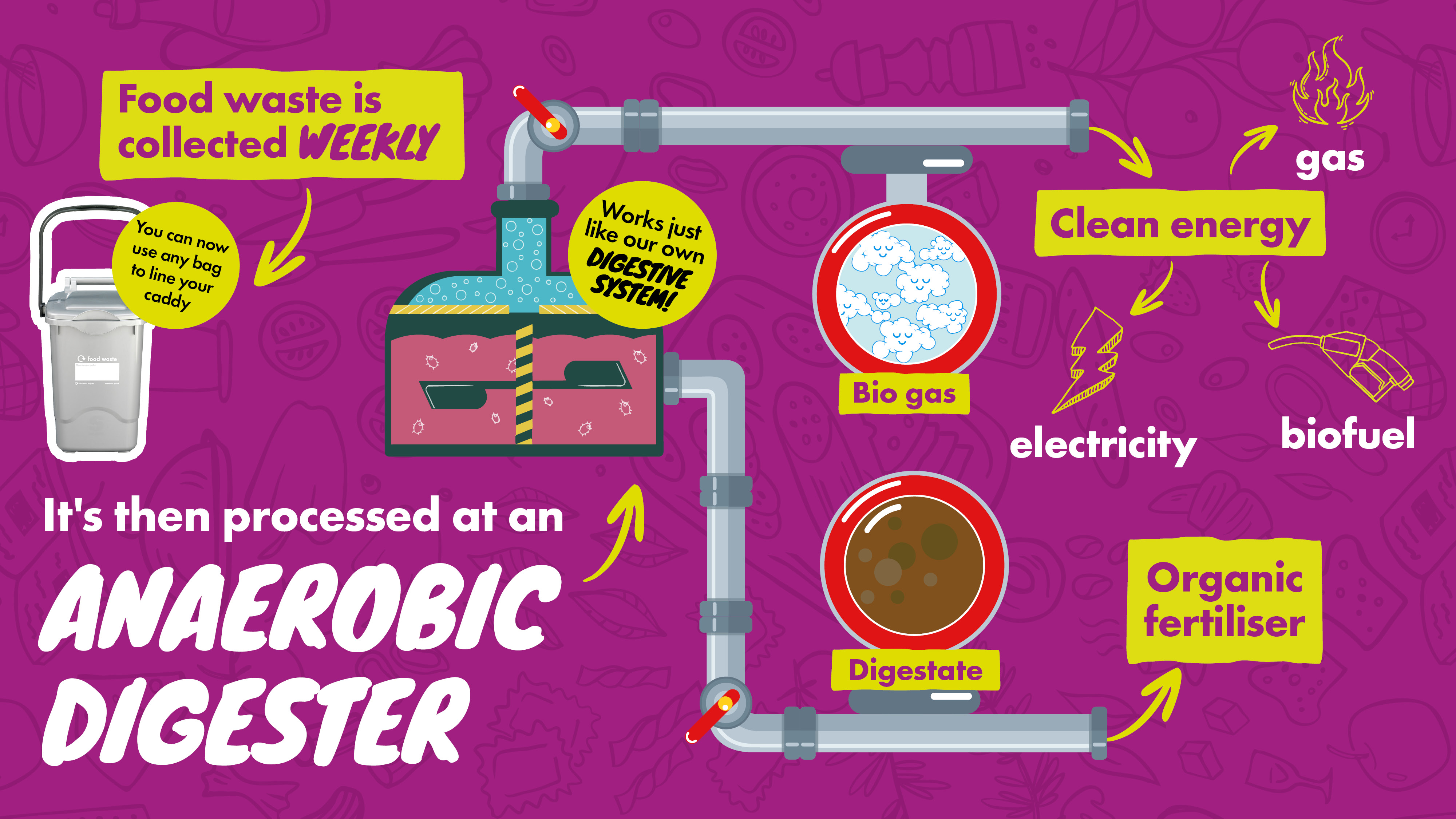
What is anaerobic digestion video
From 1 June 2026, your green lidded bin will only be used for garden waste, like grass clippings, leaves and small branches. This will be collected for composting.
Previously this mixed food and garden waste was sent for In Vessel Composting (IVC). This is expensive and no longer the best way of handling food waste. Instead, we now send your food waste to an anaerobic digester. Your garden waste goes for traditional composting.
That’s why it’s important not to put food waste in the garden bin from 1 June 2026.
An extra food waste recycling caddy can be provided for families that meet the extra rubbish bin capacity criteria, however, before issuing, we will provide advice on minimising food waste.
We encourage you to make use of your food caddies and your recycling and garden waste bins as much as possible, to reduce the waste going into your rubbish bins.